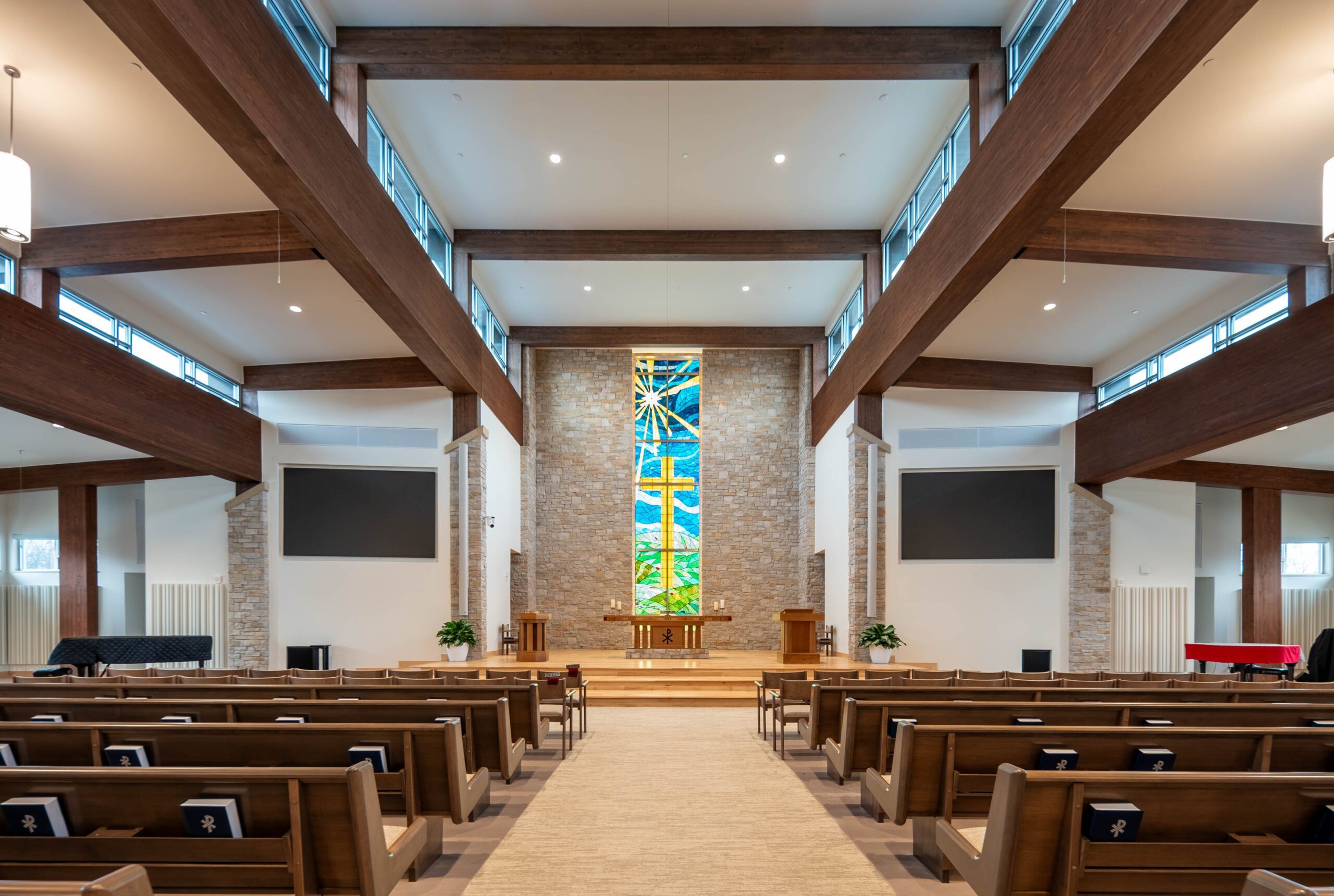

For more than two decades, Bethlehem Lutheran Church in Germantown, Wisconsin, gathered its congregation for worship in a gymnasium. While functional, the space was never meant to be permanent. Since the campus was first developed in 2000, the vision had always included a dedicated sanctuary, one that would reflect Bethlehem’s identity as a church, not just a school and childcare center.
That vision was finally realized with the completion of a new worship addition built in partnership with Catalyst Construction, creating a space that now serves as both a spiritual home and a catalyst for growth across the ministry.
From Vision to Partnership
Bethlehem’s leadership began seriously pursuing a sanctuary project around 2020. With prior construction experience on campus and a long list of considerations, budget, disruption to school operations, and congregational buy-in, the church evaluated multiple construction partners before selecting Catalyst.
According to Pastor Paul Koester, the decision ultimately came down to more than cost or credentials. Catalyst distinguished itself through its willingness to listen, collaborate, and dream alongside the congregation.
“We didn’t even really know what our budget was at first,” Koester recalled. “When Catalyst came back with a design, working with Excel Engineering, it completely blew us away. It was something unique. Something you could put on the front of a magazine.”
Equally important was the sense that Catalyst genuinely wanted the project to succeed. “You could tell they were excited about working with us,” Koester said. “That mattered.”
Designing a Sanctuary with Purpose
The project’s primary goal was clear: create a true sanctuary large enough to welcome the full congregation into one unified worship space. The result is a 525-seat sanctuary complemented by a spacious narthex, fellowship hall, kitchen, meeting areas, and support spaces, all designed to encourage connection beyond Sunday services.
One of the most striking architectural elements is the use of massive exposed glulam beams stretching up to 78 feet across the sanctuary. These beams are not only visually impactful, drawing the eye toward the altar, but also structurally integral. Catalyst worked closely with trade partners to engineer a composite solution that balanced design intent with stewardship of donor dollars.
The sanctuary is further defined by a custom stained glass installation, designed in collaboration with church members and artisans, that fills the space with light and symbolism. While the project encountered challenges related to height restrictions and framing conflicts, Catalyst, Excel Engineering, and the church worked together to resolve the issue collaboratively, preserving the integrity of the design.
Building While the Church Stayed Open
Throughout construction, Bethlehem remained fully operational, with school, childcare, and worship services continuing on site. Catalyst carefully coordinated utility shutdowns, access changes, and construction sequencing to minimize disruption.
“They were patient with us and worked around our schedule,” Koester said. “It felt very seamless.”
That spirit of partnership extended beyond logistics. Early in the project, Catalyst facilitated meaningful opportunities for congregational involvement, including a groundbreaking prayer initiative where members wrote prayers on stones that were later embedded into the foundation at the main entrance, a permanent reminder of the faith and generosity that made the project possible.
Midway through construction, Catalyst also helped organize a “Family Day,” inviting members to walk through the site for the first time. For many, it was a powerful moment, stepping through construction barriers and seeing, in real terms, what years of prayer and giving were building. “The excitement skyrocketed after that,” Koester said.
A Space That’s Already Changing Ministry
Since the sanctuary’s dedication in December, the impact has been immediate and measurable. Weekly attendance at the Germantown campus has grown from approximately 350 to more than 500, with special services drawing upwards of 800 people, a level that is already prompting conversations about adding another service.
Beyond worship, the new spaces are expanding how Bethlehem serves its congregation and community. Fellowship areas now host young-adult gatherings, informal connection after services, and ministry meetings that previously lacked a natural home. The sanctuary itself is opening new doors for weddings, concerts, and community events, reinforcing Bethlehem’s presence as a church within Germantown.
“It finally feels like people see us as a church,” Koester reflected. “Not just a school where worship happens somewhere inside.”
Lessons for Other Church Leaders
Looking back, Koester offers clear advice for churches considering a major construction project: don’t be afraid to dream. “God’s people respond with generosity,” he said. “You don’t have to settle.”
He also emphasizes the importance of choosing a construction partner who is genuinely invested in the ministry, one who sees success as shared, not transactional.
“From day one, it felt like we all wanted the same thing,” Koester said. “That made all the difference.”
A Foundation for the Future
For Catalyst Construction, the Bethlehem Lutheran Church sanctuary stands as more than a completed building. It represents what’s possible when faith, vision, and craftsmanship align, and when a construction partner approaches ministry projects with humility, creativity, and care.
For Bethlehem, it is a long-awaited answer to prayer: a sanctuary built not just for today’s congregation, but for generations still to come.
About the Author